French company
 Fast and careful delivery
 Exceptional products
 English
 Français
 Español
 Italiano
 Deutsch

Choosing and working with stabilized pine cone blocks: the complete Mercorne guide
06 May 2026
Home
Choosing and working with stabilized pine cone blocks: the complete Mercorne guide
Stabilized pinewood is one of the most unusual materials we offer in our Langogne workshops. Long confined to decorative use, it is now making a name for itself in exceptional cutlery and art turning, thanks to a technical process that transforms a fragile forest element into a dense, stable material that is exceptional to work with. Here's how to choose it, work it and get the best out of it.
Why stabilized pine needles are so attractive to exceptional cutlery makers

In its raw state, pine needles are beautiful but unusable for cutlery: too crumbly, too sensitive to humidity, too irregular. The stabilization process changes everything. By impregnating each scale and cell with a high-performance resin under vacuum, we obtain a dense, rot-proof material that can be worked like a precious wood. The pigne thus becomes a genuine art cutlery material, comparable to a rare wood burl or a classic stabilized wood - with the added bonus of a visual signature not found elsewhere.
At Mercorne, we've taken this logic a step further with vertical inclusion: the handle is positioned upright in the mold before the resin is poured. The result reveals the complete honeycomb pattern, in the form of a geometric design reminiscent of natural fractal structures. No other craftsman in France offers this level of finish.
How to choose the right pigne block for your project

Three criteria should guide your choice.
Format. For a standard knife handle insert (hunting, kitchen, EDC), a 125 × 35 × 6 mm format is calibrated for two matched inserts or a complete handle, depending on your assembly. For a jewelry cabochon or compact turning, a shorter format will suffice. Always check the usable dimension after sanding: allow a safety margin of 1 to 2 mm.
Resin color. Six shades are available in our range: khaki, orange, blue, green, yellow and apple green. The choice depends on the blade and its use. A raw stainless steel blade will go well with khaki or apple green for an outdoor look. A damascus blade, on the other hand, calls for orange or deep blue for a bold contrast.
The pattern of the blade. Each block is unique. Look at the photo of the proposed block: the regularity of the scales, the position of the heart of the pin and the density of the honeycomb pattern vary with each piece. This makes it a signature material rather than an interchangeable consumable.
Good practice when working with stabilized comb blocks

Stabilized pine is worked with the same tools as conventional hardwood. Here's the sequence tried and tested by knifemakers who pass through our workshop.
1. Cutting and drilling. Fine-toothed band saw, medium speed, without forcing. The resin can heat up if the blade is too aggressive: let the material evacuate the heat. For drilling, a standard wood bit is sufficient, avoiding high speeds.
2. Progressive sanding. Start with 120 grit for shaping, then move up gradually: 240, 400, 800, 1200, 2000. Never skip a step. With each step, the honeycomb pattern becomes sharper and the contrast with the resin intensifies.
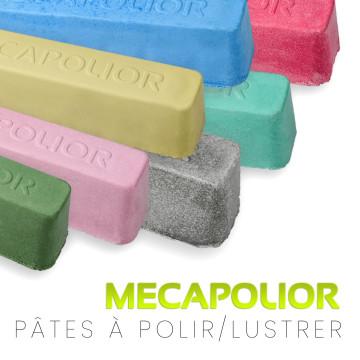
3. Mirror polishing. A standard polishing paste (white paste followed by red paste) on a cloth disc gives a mirror-like polish in just a few minutes. The resin and stabilized wood take up the polish simultaneously, with no halo formation. This is one of the great advantages of this material over unstabilized natural inclusions.
4. Finishing. No oil or wax is required. Stabilization has already saturated the material. A soft cloth is all that's needed for the final finish.
Mercorne know-how: 34 years at the service of cutlers
Mercorne has been supplying French and European cutlery makers with materials for knife handles since 1992. Our Langogne workshop controls the entire chain: selection of raw materials, vacuum stabilization, resin casting, cutting and packaging. The vertical pine handle is one of our signature creations: a product designed, manufactured and traced in France, which encapsulates the very best of what we know how to do.
If you're working with this material for the first time and have technical questions, contact Olivier at contact@mercorne.fr. He will personally answer all your cutlery queries.
Have a nice day.
Category
Blog Archive
Blog Search
Popular Articles
Jamaican rain tree (Ebony Brya)
17 Jun 2025

End-of-2026 trade shows
25 Jun 2026

Recent Articles

End-of-2026 trade shows
25 Jun 2026