No products available yet
Stay tuned! More products will be shown here as they are added.

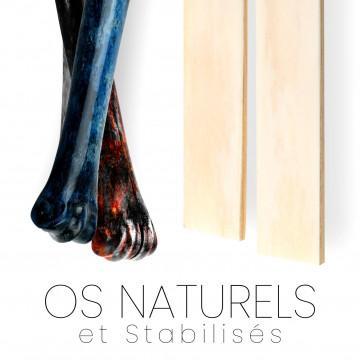
Ostrich bone(Struthio camelus) is one of the most unusual bone materials available for cutlery. Derived from the largest living bird - bred mainly in South Africa and Europe - it is distinguished by its dense trabecular structure, natural hues ranging from creamy white to warm beige, and unique surface patterns. Its relative lightness compared to mammal bone, combined with good hardness, makes it a popular choice for knife makers seeking a rare visual effect and easy workshop work.
At Mercorne, ostrich bones are selected piece by piece for the consistency of their texture and the quality of their drying. Cut in our workshop in France, they are offered in natural and stabilized versions to suit all projects. Our catalog includes slabs, wafers and ready-to-shape sections. Any doubts about format or finish? Olivier can personally answer your technical questions.
Stay tuned! More products will be shown here as they are added.
The ostrich(Struthio camelus) is the largest living bird, reaching heights of over 2.50 m and weighing 150 kg. Native to the savannahs and steppes of sub-Saharan Africa, it is now farmed on several continents - South Africa, Namibia, Zimbabwe, as well as France and Spain - for its meat, skin and feathers. Its bones, particularly those of the lower limbs, have a dense, compact structure that clearly distinguishes them from the bones of other poultry. Long under-utilized in Western craftsmanship, they have gradually found their way into cutlery thanks to their characteristic surface texture and availability from controlled farms with no CITES issues.
Ostrich bone has a moderate density, lower than that of camel bone but higher than that of many light woods. Its natural surface is smooth to slightly grainy, with a cream to beige color, sometimes crossed by veins or golden hues depending on the section used. Its trabecular internal structure - visible on certain cuts - creates natural patterned effects that sanding and polishing gradually reveal.
Ostrich bone is easy to work in the workshop: sawing, drilling, sanding and polishing present no particular difficulty with standard cutlery tools. It can be fastened with screws or rivets, provided they are not over-tightened. Its sensitivity to humidity is real - like all natural bones - which justifies the interest of stabilized versions for handles intended for intensive use or a damp environment.
Vacuum stabilization impregnates the bone with a resin that fills micro-pores, eliminates sensitivity to humidity and fixes the color. It also enhances overall mechanical strength and facilitates mirror polishing. For knife handles intended for sale or everyday use, the stabilized version is recommended.
The choice between natural bone and stabilized bone depends mainly on the intended use and the level of finish required:
Ostrich bone pairs well with mirror-polished or satin-finish stainless steels, as well as with damascus, which creates an elegant textured contrast. Brass, nickel silver or titanium plates complete the harmonious ensemble.
Mercorne has been offering ostrich bones for many years, selected from suppliers with controlled breeding and processing practices. Each piece is cut in our workshop in France, according to standardized formats facilitating direct processing. Our catalog includes the most common formats - wafers, slabs and sections - in natural dried and stabilized versions. Products in stock are dispatched on the day of order, with free delivery for orders over €90, and returns accepted within 15 days.
No. The ostrich(Struthio camelus) is a species bred on a large scale and not protected by the CITES convention. Unlike elephant ivory or the tusks of protected mammals, the purchase, sale and use of ostrich bones in cutlery does not require any specific regulatory document.
Natural bone retains its original color and texture, but remains sensitive to humidity, which can cause slight dimensional shifts. Stabilized bone is impregnated with resin under vacuum: it becomes insensitive to humidity, more mechanically resistant and easier to polish. For a knife intended for regular use, the stabilized version is recommended.
Regular polishing with mineral oil or beeswax is sufficient to protect the surface and preserve the bone's natural lustre. Avoid soaking the handle in water, and wipe it dry promptly after wet use. Stabilized bones do not require this special care.
Yes, it's an accessible material. It can be sawn, drilled and sanded without difficulty using standard tools. The only constraints are those common to all bones: avoid overheating when drilling, and work the abrasive grains progressively to obtain a fine surface polish.
check_circle
check_circle
What are you looking for?