No products available yet
Stay tuned! More products will be shown here as they are added.

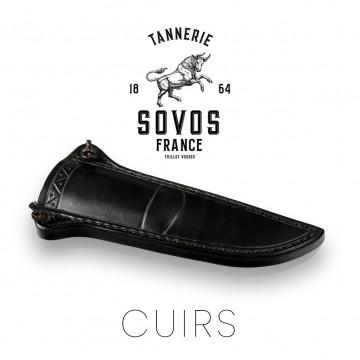
Vegetable-tanned leather is the benchmark material for handcrafted knife sheaths. An ancestral process using bark and natural plant extracts, vegetable tanning produces a firm, dense leather with an evolving patina: it improves with use, taking on shapes and developing a unique appearance over time. Supple to work with, yet remarkably durable, it adapts perfectly to the demands of cutlery - blade protection, secure hold, and extensive customization possibilities through stamping, dyeing or engraving. Mercorne offers leathers from a direct partnership with Tannerie SOVOS, a French firm renowned by professional and amateur cutlers alike for its consistent tanning.
At Mercorne, each piece is selected for its consistency, thickness and suitability for workshop work: cutting, sewing, molding, edge finishing. The range has been co-developed with local knifemakers to offer formats accessible to beginners and experienced knifemakers alike. Any doubts about thickness or rigidity? Olivier can personally answer all your technical questions.
Stay tuned! More products will be shown here as they are added.
Vegetable tanning is one of the oldest animal hide processing techniques. It is based on the use of tannin-rich natural extracts - oak, chestnut, mimosa or quebracho bark - which stabilize leather fibers over a period ranging from several weeks to several months, depending on the tannery. This slowness is precisely what gives vegetable-tanned leather its distinctive qualities: density, initial firmness, and a unique ability to develop a deep patina with use. Tannerie SOVOS perpetuates this tradition with respect for French know-how, producing bull hides of a consistency appreciated by cutlery craftsmen.
Vegetable-tanned leather has a very distinct technical profile from chrome-tanned leather, which is softer but less structured:
The choice of leather depends on several parameters linked to the project and the cutler's level of expertise:
If in doubt, Olivier is on hand to advise you on the right size and thickness for your project.
Mercorne chose to work exclusively with Tannerie SOVOS after several months of testing with local cutlers. The objective was clear: to identify a reliable vegetable-tanned leather, consistent from one order to the next, and adapted to the specific uses of cutlery - blade protection, rub resistance, durability. The result is a tightly-packed range, with no compromise on quality, offered in pieces of dimensions consistent with the needs of the workshop. As with all Mercorne materials, SOVOS leathers are packaged and shipped from our workshop in France, with free delivery on orders over €90, and returns accepted within 15 days.
Vegetable tanning produces a firmer, more structured leather, suitable for molding or engraving. Chrome-tanned leather is softer and more water-resistant, but does not take shape as well, nor does it take decorative work as well. For handcrafted knife sheaths, vegetable tanning is the preferred choice.
Yes, leathers with a natural or fawn finish can be dyed with water or alcohol. Apply the dye after cutting and before assembly for a uniform result. A beeswax or lanolin finish protects the edges and surface.
Nourish the leather once or twice a year with a neutral grease or beeswax. Avoid prolonged exposure to water. In the event of accidental wetting, allow to dry in the open air, away from a source of heat, then nourish again.
Absolutely. Scraps can be reused for belt loops, workshop protection martyres, sheathed handles or small accessories. Mercorne's lump format limits waste and can be adapted to a variety of projects.
check_circle
check_circle
What are you looking for?