No products available yet
Stay tuned! More products will be shown here as they are added.

Violet rosewood(Dalbergia cearensis) is one of the most prized species in cutlery for its remarkable color, in shades of deep violet, brown and black with golden highlights. Native to Brazil, this exceptional wood has a very fine, dense grain, a smooth surface texture and a ribbed veining that makes each piece unique. Its natural hardness and stability make it a first-rate material for knife handles designed to last.
At Mercorne, we select each block and plank of violet rosewood with the care that such a precious species requires. Our materials are cut in our workshop in France, in formats suited to artisan cutlery. Please note: violet rosewood(Dalbergia cearensis) is listed in Appendix II of the CITES Convention - regulatory obligations apply to its trade; we invite you to consult our blog to learn more before ordering.
Stay tuned! More products will be shown here as they are added.
Purple wood, scientifically known as Dalbergia cearensis, is a precious wood native to northeastern Brazil, mainly in the state of Ceará. It belongs to the vast Dalbergia genus, which includes rosewoods and other dense woods from South America, Africa and Asia. Nicknamed "kingwood" in English or "bois de violette" in the French cabinetmaking tradition, it was already prized under the Ancien Régime for marquetry and royal furniture. Today, its most noble applications are in cutlery and violin making. Dalbergia cearensis is listed in Appendix II of the Washington Convention (CITES): its international trade is regulated and requires traceability documents. Mercorne only offers violet rosewood from legal sources that comply with these regulations.
Purple wood is extremely dense, with an estimated density of between 0.95 and 1.10 g/cm³ [À VÉRIFIER], making it one of the heaviest and hardest woods available for cutlery. This density makes it particularly resistant to impact, wear and moisture.
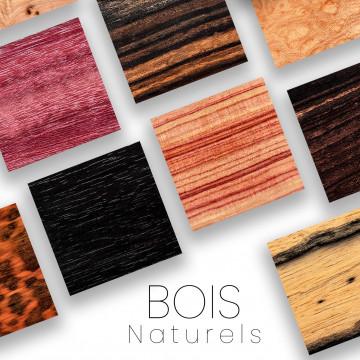
Its color ranges from dark violet to brown-black, with streaks alternating between golden yellow, deep violet and black. This high-contrast ribbon veining is the visual signature of violet rosewood; each piece presents a unique pattern. Over time, when exposed to light, the wood tends to darken slightly to a rich purplish-brown.
Despite its hardness, violet rosewood works well with cutting tools. Its very fine, even grain allows sanding to mirror finishes without excessive clogging of abrasives. The natural oils present in the wood make it easy to obtain a glossy natural polish, sometimes without the need for additional oil. However, it also accepts knife-finishing oils to enhance its sheen.
Violet rosewood is suitable for a wide range of knifemakers, but its price and rarity make it an ideal choice for pieces with a strong character:
It goes particularly well with brass, alpaca or carbon fiber spacers, which bring out its purplish hues.
Since 1992, Mercorne has been selecting and cutting noble materials for artisan cutlery in its Puy-de-Dôme workshop. Violet rosewood is one of the species we offer for its exceptional aesthetic and technical interest, with the rigorous traceability required by CITES regulations. Each piece is cut in France, in formats standardized for cutlery (plates, blocks, slices). Our guarantees: same-day dispatch for orders placed before 12 p.m., returns accepted within 15 days, free delivery for orders over €90. In doubt about the format or quality of a piece? Olivier will personally answer your technical questions.
Yes, it is legal to buy and hold for handcrafted purposes in France. Appendix II of CITES regulates international trade in the species, which mainly concerns imports and exports. Mercorne guarantees that the pieces on offer come from sources that comply with current regulations. See our blog for details of applicable obligations.
The term "rosewood" most often refers to Dalbergia cearensis in the French cabinetmaking tradition - the same wood as our purple rosewood. In contemporary cutlery, the two designations coexist. Other species of the Dalbergia genus are sometimes marketed under similar names; always check the Latin name to avoid confusion.
Violet rosewood naturally contains oils that protect it from humidity, but periodic care with mineral oil or baked linseed oil prolongs its life and revives its sheen. Avoid prolonged soaking in water, and dry the neck area thoroughly after each heavy use.
Yes, as long as it is finished with a food-grade oil. The wood itself has no known contraindications, but the finish and watertightness of the blade-handle assembly are the decisive points for hygiene in a food context.
Absolutely. The hardness of the wood makes reworking a little more laborious than with softer species, but the result is excellent. Progressive sanding down to 400 or 600 grain, followed by paste polishing, restores the piece to an almost new appearance.
check_circle
check_circle
What are you looking for?