No products available yet
Stay tuned! More products will be shown here as they are added.

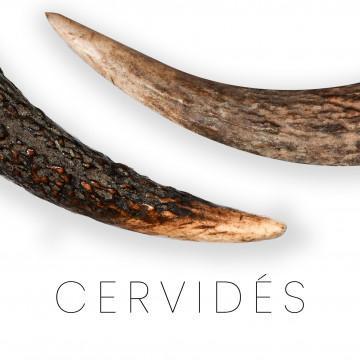
Stabilized spongy deer antler is a rare and distinctive material derived from the antler of the red deer (Cervus elaphus), cut lengthwise. This cut reveals the internal spongy, honeycomb-like structure of the antler, with its natural hues ranging from ivory white to warm brown. After stabilization, the material gains strength and moisture resistance far superior to that of the raw material, while retaining its unique organic appearance. For knife makers, it offers a distinctive visual appeal that is immediately recognizable.
At Mercorne, this material has been selected and stabilized in our workshop in Lozère for over 34 years. Each piece is inspected to ensure a uniform structure and optimal grip. The pieces are sold in matched pairs to facilitate the creation of symmetrical handles. Have questions about selection or use? Olivier personally answers your technical questions.
Stay tuned! More products will be shown here as they are added.
Spongy deer antler is extracted from the antler log of the red deer (Cervus elaphus), one of the most widespread species of deer in Europe. Unlike the slats sawn from the cortical antler, this material is obtained by making a longitudinal cut through the antler log, revealing the naturally honeycombed inner portion of the antler structure. This spongy area, also known as trabecular bone tissue, has a very distinct honeycomb texture that is unique to each animal. Before being used in cutlery, the plates undergo a stabilization process that involves impregnating the porous material with resin under vacuum, making it denser, waterproof, and more durable over time.
Stabilization profoundly transforms the behavior of spongy deer antler. In its raw state, the honeycomb structure is fragile and highly sensitive to humidity. After treatment, the material becomes firm, easy to machine, and resistant to changes in humidity. It is this combination of apparent lightness and acquired strength that makes it a suitable material for crafting knife handles.
The natural color ranges from creamy white to beige and brown, depending on the animal and the area from which it was cut. The honeycomb structure is visible on the surface and creates a unique organic pattern that cannot be replicated exactly from one piece to the next. Some slabs exhibit very pronounced color transitions between the cortical and spongy zones.
After stabilization, deer spongy wood can be easily worked with a file, sandpaper, and a gentle sander. It can be polished with oil or wax. It is recommended to use well-sharpened tools and apply gradual movements to preserve the surface honeycomb structure. A matte or satin finish is generally recommended to highlight the material’s natural texture.
This material is suitable for a variety of knife designs, provided the project is adapted to its visual and structural characteristics:
This material is not suitable for projects requiring a completely smooth and uniform surface. Its value lies precisely in its natural and organic irregularity.
Mercorne has been selecting and stabilizing this material in its workshop in Lozère for over 34 years. Each red deer log is inspected before cutting: only areas with a regular honeycomb structure and no structural defects are retained. The slats are sold in matched pairs, which simplifies the design of symmetrical handles. Stabilization is carried out in France in accordance with current standards. Orders are shipped the same business day, with free shipping on orders of €90 or more and returns accepted within 15 days.
Cortical deer antler refers to the dense, compact outer layer of the antler. Spongy antler, or trabecular tissue, is the inner, honeycomb-like portion. Both materials come from the same deer, but their appearance, texture, and machinability differ significantly. Spongy antler offers a more organic and textured visual appearance.
Yes. At Mercorne, stabilized spongy deer antler is sold in matched pairs: the two blanks in each pair come from the same log and are cut symmetrically, making it easier to create visually balanced handles.
Yes. The resin injected during the stabilization process fills the pores and forms a stable matrix within the material. Once cured, it remains stable over time and is highly resistant to moisture and the normal temperature fluctuations experienced by a knife handle in daily use.
Occasional treatment with mineral oil or a neutral wax is sufficient to preserve the handle’s appearance. Avoid prolonged immersion in water. Stabilization effectively protects the material, but regular care extends the handle’s lifespan and maintains its appearance.
The deer antler used by Mercorne comes from the natural shedding of deer or from deer hunted as part of regulated hunting programs in Europe. No animals are killed specifically for this material. Mercorne verifies the traceability of its supply chain.
check_circle
check_circle
What are you looking for?