No products available yet
Stay tuned! More products will be shown here as they are added.

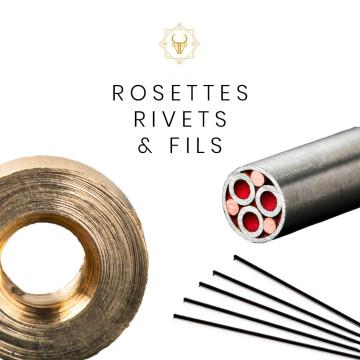
The mosaic rivet is an essential decorative accessory in artisanal cutlery. Consisting of a hollow cylinder made up of stainless steel, carbon steel, or brass tubes embedded in resin, it features a cross-section with precise, repeatable geometric patterns. Attached to the handle by gluing—rather than riveting—it adds a refined aesthetic touch without adding weight to the piece. Some models are perforated and can also serve as lanyard loops.
At Mercorne, our mosaic rivets come from Germany and our own production facilities, ensuring a rigorous selection of patterns and materials. Our catalog offers a wide range of diameters, material combinations, and designs to suit everything from understated finishes to the most elaborate creations. Not sure which diameter or pattern is right for your project? Olivier will answer your questions directly.
Stay tuned! More products will be shown here as they are added.
The mosaic rivet originated in the tradition of European cutlery, particularly German cutlery, where artisans sought a way to decorate handles with repeatable, geometrically precise elements. The principle is simple: tubes made of different materials—stainless steel, carbon steel, brass—are assembled within a resin cylinder, then sliced to reveal a cross-sectional pattern. Each slice thus becomes an identical decorative element, infinitely reproducible, while retaining a warm, handcrafted look. Mercorne offers mosaic rivets sourced from Germany as well as from its own production, providing a range that spans from the most classic patterns to the most original designs.
Mosaic rivets are distinguished by several technical characteristics that are worth understanding before selecting them for a project.
The core of the rivet consists of metal tubes or composite materials—304 stainless steel, carbon steel, brass—held together by a resin filler. The outer diameter is standardized to fit standard hole sizes (6 mm, 8 mm, 10 mm, and larger depending on the model). The raw length allows you to cut as many decorative washers as needed based on the desired thickness.
The cross-sectional patterns vary depending on the arrangement of the tubes: concentric circles, geometric lattices, stars, honeycomb patterns, and spirals. The combination of materials creates striking visual contrasts—the black of carbon steel against the shine of stainless steel, or the gold of brass against a dark background. Some collections feature colored inserts made of tinted resin for even more striking effects.
Unlike traditional rivets, mosaic rivets are never countersunk: they are inserted into a blind or through hole and bonded with epoxy resin. It is important to take this installation requirement into account from the very beginning of the handle’s design to ensure the correct drilling and the use of the appropriate adhesive.
The choice of a mosaic rivet depends on several factors that must be evaluated based on the project:
Mercorne has been carrying mosaic rivets for many years, sourcing them from specialized German manufacturers and developing its own compositions to offer exclusive designs. Each item is inspected upon receipt to verify the quality of the assemblies, the consistency of the patterns, and the accuracy of the diameters. Orders are shipped from our workshop in France upon receipt of payment, with free shipping on orders of €90 or more. Returns are accepted within 15 days for any uncut items. For any questions about the compatibility of a rivet with a specific project, Olivier is available by email or phone.
Two-component epoxy resin is the standard choice for installing mosaic rivets. It ensures a strong bond between the rivet and the handle material, resistant to moisture and temperature fluctuations. Avoid cyanoacrylate adhesives for assemblies subject to mechanical stress.
No. The composite structure of the mosaic rivet—resin and tubes—cannot withstand hammering. Any attempt to hammer it down risks shattering the rivet or cracking the handle. The only approved fastening method is bonding after drilling.
A thickness of 3 to 5 mm is generally recommended so that the pattern is visible in cross-section. If the thickness is less than 2 mm, the details of the design may be lost after sanding and polishing. The final thickness should be adjusted according to the desired aesthetic and the depth of the recess in the handle.
Yes, provided the handle material allows for clean drilling. Wood, horn, bone, synthetic materials, and composites all work very well with glued mosaic rivets. For fragile or very hard materials, drill a pilot hole first to prevent splintering.
A mosaic rivet is a solid (or hollow) cylinder that is inserted into the handle; it is invisible from the edge and visible only in cross-section. A rosette, on the other hand, is a flat disc placed on the surface of the handle around a screw or a fastening rivet. Both elements can be used together to enhance the decoration of a knife.
check_circle
check_circle
What are you looking for?